

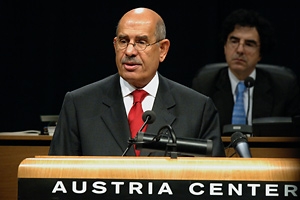
Appointed to a third consecutive 4-year term, IAEA Director General Mohamed ElBaradei today reviewed a range of nuclear challenges and opportunities facing the Agency and its Member States. Dr. ElBaradei addressed the opening session of the weeklong IAEA General Conference in Vienna.
"As we look to the future, it is important that our vision be clear and ambitious - for much remains to be done,´ he said. He specifically outlined visions for the fields of nuclear power, nuclear safety, nuclear security, nuclear safeguards, and applications of nuclear science and technology.
- Nuclear Verification: He cited priorities for universalizing the additional protocol; expanding the implementation of integrated safeguards; normalizing safeguards in Iraq; bringing the DPRK (North Korea) back to the NPT regime; providing the required assurances about Iran´s nuclear programme; and continuing to investigate the nature and extent of the illicit procurement network. In addition, he pointed out the need to arrest the dissemination of sensitive fuel cycle activities and to develop a framework for their multilateral management. "The current challenges to international peace and security, including those related to nuclear non-proliferation and nuclear arms control, cannot be wished away, and will continue to stare us in the face," he said. "All States must step up and pursue, at the highest policy levels, the urgently needed reforms to our global security system."
- Nuclear Security: As the world evolves towards a more mature global nuclear security framework, he said it is important to develop a "clearer overall picture of remaining security vulnerabilities"".
- Nuclear Safety: He urged emphasis on broader national participation in international safety conventions, greater use of IAEA safety reviews, and enhanced coordination among the IAEA and international nuclear safety bodies to ensure that efforts are complementary and mutually reinforcing. "The Agency must continue to promote a global nuclear safety regime," he said.
- Nuclear Power: He urged greater focus on "energy for development", calling the energy shortages in developing countries a "major impediment" to efforts to end poverty.
- Nuclear Applications: "We should continue to seek out new applications in which nuclear technology can offer tangible benefits to society," he said, citing developments in fields of biotechnology, nanotechnology, among others.
Among changes and achievements over the past years, Dr. ElBaradei pointed to a number of advances. They include progress in innovative systems for nuclear power; multilateral approaches to the nuclear fuel cycle; key contributions of nuclear applications to the world´s goals for food security, health care, water resources, environmental protection, and other human needs. He singled out a joint initiative of the IAEA and World Health Organization called PACT that aims to help developing countries improve cancer care and treatement. He said the Agency´s technical cooperation programme "continues to be a principal mechanism for implementing the IAEA´s basic mission of ´Atoms for Peace´".
In areas of nuclear safety and security, the Director General pointed to progress related to international conventions, safety standards, radiation protection, radioactive waste management, and the multi-agency Chernobyl Forum, which recently issued a landmark report on the 1986 accident´s consequences. Regarding nuclear security, Dr. ElBaradei said that the Agency´s activity has undergone "major expansion" over the past four years.
Concerning nuclear verification, he said times have changed, bringing new challenges. "We have clearly made progress on some fronts, but perhaps regressed on others," he said. "The Agency´s resumption of inspections in Iraq, the termination of inspections in the DPRK, our investigation of clandestine nuclear programmes in the Libyan Arab Jamahiriya and the Islamic Republic of Iran, the discovery of illicit nuclear procurement networks and the lack of agreement at the 2005 NPT Review Conference have put the spotlight on an unprecedented array of challenges to the non-proliferation and arms control regime."